


Starting a Business in Colombia: The Complete Guide for Foreign Entrepreneurs (2026)

Actualizado: 13 jul
Thinking About Starting a Business in Colombia? So Was I.
When I first began looking seriously at Colombia, I had many of the same questions you're probably asking yourself today.
Could a foreigner really own a business here?
Would I need a Colombian business partner?
How difficult would the paperwork be?
Would I need a visa—and if so, which Colombia visa would be the right one for my circumstances?
Could I open a Colombian bank account?
What would the taxes be like?
And perhaps most importantly, would moving my business to Colombia actually be a good decision?
After living in Colombia for several years, becoming a permanent resident, establishing and operating a Colombian business, opening local bank accounts, working with government agencies and helping thousands of international clients through our company, I've discovered that the reality is often very different from what many people expect.
Like every country, Colombia has its challenges. There is paperwork, regulations and procedures that need to be followed carefully. However, there are also tremendous opportunities for entrepreneurs prepared to understand the local market and take advantage of one of Latin America's most dynamic economies.
This guide combines official information, practical experience and real-world advice to help you understand not only how to start a business in Colombia, but what it's actually like to build and operate one here.
Whether you're considering opening a consultancy, launching an online business, investing in property, establishing a technology company, opening a café, importing products or expanding an existing business into Latin America, this guide will walk you through the process step by step.
By the end, you'll have a clear understanding of what is involved, the costs you can expect, the legal requirements, common mistakes to avoid and the opportunities that make Colombia such an attractive destination for entrepreneurs from the United States, Canada, the United Kingdom and beyond.
If you're still deciding which immigration pathway best supports your business plans, our comprehensive Colombia Visa Guide compares all of Colombia's principal visa categories—including the Business, Investment, Digital Nomad, Retirement and Marriage Visas—and explains the eligibility requirements, documentation and practical considerations for each. It provides an excellent starting point before deciding which visa is best suited to your long-term plans in Colombia.
Why I Decided to Write This Guide
Over the years I've read countless articles about starting a business in Colombia.
Many were technically accurate.
Some were badly out of date.
Others had clearly been written by people who had never actually gone through the process themselves.
Most simply repeated information available on government websites without explaining what any of it meant in practice.
That's not particularly helpful when you're preparing to relocate your life or invest your savings.
My own journey has been very different.
As a British entrepreneur, I chose to make Colombia my home. Since then I've obtained Colombian residency, established a business here, opened local bank accounts, worked with accountants, lawyers and government agencies, and learned first-hand how the Colombian business system operates.
Along the way there were pleasant surprises, occasional frustrations and many lessons that simply don't appear in official guides.
Those experiences have shaped this article.
Rather than producing another checklist copied from government websites, my aim is to explain the practical side of doing business in Colombia—the questions people actually ask before making such an important decision.
Why Trust This Guide?
This guide has been prepared by the team at Altus Traducciones®, a Colombia-based translation company owned and managed by a British entrepreneur who now calls Colombia home.
Every day we work with people relocating to Colombia for investment, employment, marriage, retirement, study and business. We regularly assist international clients who need official documentation prepared for immigration procedures, company registration, banking, property purchases and legal matters. All official translations are prepared exclusively by accredited Official Translators, whose qualifications and legal appointment are explained in our guide on 👉 How to Become an Official Translator in Colombia (en español)
Those experiences have provided a unique perspective on the practical challenges foreigners encounter when establishing themselves in Colombia.
Altus Traducciones® is proudly:
✅ A registered trademark (Marca Registrada) in Colombia.
✅ ISO 9001:2015 certified for quality management.
✅ Based entirely in Colombia.
✅ Trusted through more than 1,000 verified client reviews, making us one of Colombia's most highly reviewed translation companies.
Although this guide is not intended as legal or tax advice, it has been written by people who genuinely understand the journey because we've lived it ourselves.
Why Colombia?
If you had asked many international entrepreneurs twenty years ago whether they would consider opening a business in Colombia, relatively few would have said yes.
Today, the conversation is very different.
Colombia has transformed dramatically over the past two decades.
Modern cities, improved infrastructure, a growing middle class, an increasingly digital economy and strong international connections have made the country an attractive destination for investors and entrepreneurs alike.
Compared with many North American and European cities, operating costs remain highly competitive while the quality of life continues to attract professionals from around the world.
For many foreigners, Colombia offers something increasingly difficult to find elsewhere—a genuine opportunity to build a successful business while enjoying an excellent lifestyle.
Why 2026 Could Be an Excellent Time to Start a Business
Every entrepreneur understands that timing matters.
Colombia enters an important new chapter on 7 August 2026, when President-elect Abelardo de la Espriella assumes office.
Throughout his campaign he spoke extensively about encouraging entrepreneurship, attracting foreign investment, reducing unnecessary bureaucracy, simplifying regulations and creating a more competitive tax environment for businesses.
Naturally, campaign promises must still be translated into legislation, and many proposals will depend on approval by Congress. However, there is considerable optimism within Colombia's business community that the coming years could bring meaningful reforms aimed at making it easier to invest and operate a business.
For anyone considering Colombia as a destination for investment or relocation, it is certainly a period worth watching closely.
More Than Low Costs
One misconception I often hear is that foreigners move to Colombia simply because it's cheaper.
Lower operating costs are certainly attractive.
Office space, professional services, salaries and many day-to-day expenses can be considerably lower than in cities such as Miami, Toronto or London.
However, after living here, I believe that's only part of the story.
People stay because of the opportunities.
Colombia has a young, entrepreneurial population, a growing consumer market, talented professionals, improving digital infrastructure and a strategic location that provides access to both North and South America.
It's also a country where relationships matter.
Building trust, taking time to understand the culture and working with reliable local professionals often opens doors that aren't immediately obvious to newcomers.
💡 From Experience
One of the biggest surprises for me was discovering that many procedures which appeared intimidating before I arrived were actually quite manageable once I understood the order in which they needed to be completed.
Preparation makes an enormous difference.
Having the correct documents, obtaining official translations where required, working with a knowledgeable accountant and understanding the role of each government agency can save weeks of unnecessary delays.
That's one of the reasons I've included practical tips throughout this guide rather than simply explaining the legal requirements.
This Guide Will Save You Time
Starting a business anywhere involves making dozens of decisions.
In Colombia you'll also encounter terms such as NIT, RUT, DIAN, Chamber of Commerce, electronic invoicing, social security contributions and many others that may initially seem confusing.
By the end of this guide you'll understand:
whether foreigners can own 100% of a Colombian company;
which business structure is usually the best choice;
how long company registration normally takes;
what it typically costs to establish and operate a business;
how taxation works;
how to open a Colombian business bank account;
whether you need a visa;
how to hire employees legally;
and the common mistakes that are easily avoided with the right preparation.
Most importantly, you'll gain a realistic understanding of what it's actually like to do business in Colombia from someone who has experienced the process first-hand.
In the next section, we'll answer one of the most common questions of all:
Can foreigners really start and own a business in Colombia?
Can Foreigners Start a Business in Colombia?
The short answer is yes.
In fact, one of the things that surprised me most when I first began researching Colombia was just how welcoming the country is towards foreign investment.
Many people assume that, as a foreign citizen, you'll need a Colombian business partner, permanent residency or even Colombian citizenship before you can establish a company.
Fortunately, that's generally not the case.
In most circumstances, foreign nationals can legally own 100% of a Colombian company, invest in Colombian businesses and manage their operations, provided they comply with Colombian commercial, tax and immigration regulations.
This openness to foreign investment has helped attract entrepreneurs from the United States, Canada, the United Kingdom, Europe and many other parts of the world, all looking to establish businesses in one of Latin America's fastest-growing economies.
Do I Need to Be a Colombian Resident?
Another question I'm asked regularly is:
"Do I need a Colombian visa before I can start a business?"
The answer depends on what you intend to do.
From a company ownership perspective, it is entirely possible for a foreigner to establish or own a Colombian company without first becoming a permanent resident.
However, if your intention is to live and work in Colombia, you'll almost certainly want to choose the visa that best matches your circumstances. Our comprehensive Colombia Visa Guide compares all of Colombia's principal visa categories—including the Business, Investment, Digital Nomad, Retirement and Marriage Visas—and explains who each visa is designed for, the eligibility requirements and the supporting documentation commonly required. It's an excellent starting point before deciding which immigration pathway best supports your business and long-term relocation plans.
For example, entrepreneurs investing in Colombia may qualify for an Investment Visa, while others may initially arrive under a different immigration category before establishing their business.
If you're planning to relocate through investment, our comprehensive Investment Visa Colombia guide explains the current requirements, investment thresholds and long-term residency options available to foreign investors. Likewise, if you're currently working remotely and considering relocating before launching a Colombian business, our Digital Nomad Visa Colombia guide explains another increasingly popular immigration pathway.
Likewise, if you're currently working remotely and considering relocating before launching a Colombian business, our guide to the Digital Nomad Visa Colombia explains another increasingly popular route.
💡 From Experience
One of the biggest advantages of planning ahead is that your business structure, banking arrangements and visa strategy can often complement one another. Taking a little extra time at the beginning can save considerable time and expense later.
Can I Own 100% of My Colombian Company?
For most business activities, yes.
Unlike some countries that require local shareholders or impose restrictions on foreign ownership, Colombia generally allows foreign investors to own 100% of the shares in their company.
That means you remain in complete control of your business.
Whether you're opening:
an online consultancy,
a software company,
a digital marketing agency,
a property management business,
an import-export company,
a café,
a restaurant,
a retail business,
or a professional services company,
full foreign ownership is normally permitted.
There are, of course, regulated industries where additional licences or approvals may be required, but for the vast majority of small and medium-sized businesses established by foreign entrepreneurs, complete ownership is perfectly acceptable.
Is Colombia Business-Friendly?
Based on my own experience, I would answer yes—but with realistic expectations.
No country is perfect.
Every country has bureaucracy.
If you've ever started a company in the UK, Canada or the United States, you'll already know that paperwork is simply part of doing business.
Colombia is no different.
What I have found encouraging is that many procedures have become increasingly digital over recent years.
Government agencies now offer many services online, electronic invoicing has modernised the tax system and company registration is considerably more straightforward than many foreigners imagine.
As with anywhere else, success often comes down to preparation.
Having the correct documentation from the outset, using an experienced accountant and understanding the order in which different procedures need to be completed makes the process significantly smoother.
Some foreign-issued documents may also need to be officially translated into Spanish before they can be used in Colombia. If you're unfamiliar with Colombia's legal translation system, our guide to Official Translators in Colombia explains who is legally authorised to prepare official translations, when they are required and how to ensure your documents meet Colombian legal requirements.
💡 From Experience
One lesson I learned very quickly was not to assume that procedures work exactly as they do back home.
In Colombia there may be additional forms, certified copies or official translations required at various stages.
Rather than seeing this as bureaucracy for its own sake, I found it easier to accept that every country has its own way of doing things.
Once I adjusted my expectations, the process became much less frustrating.
Which Business Structure Is Best?
One of the first decisions you'll make is choosing the legal structure of your company.
Although Colombia offers several different types of business entity, one stands out as the preferred choice for the overwhelming majority of foreign entrepreneurs.
That is the Sociedad por Acciones Simplificada (SAS).
The SAS has become incredibly popular because it combines flexibility with relatively straightforward administration.
Among its advantages are:
✅ It can usually be established quickly.
✅ It can have a single shareholder.
✅ It allows 100% foreign ownership.
✅ Shareholders generally enjoy limited liability.
✅ It is suitable for both small businesses and larger companies.
Because of these benefits, you'll find that accountants and lawyers frequently recommend the SAS structure unless your circumstances require something different.
We'll examine the various business structures in much greater detail later in this guide so you can decide which is most appropriate for your particular situation.
What Documents Will You Need?
The exact requirements vary depending on your nationality, business activity and visa status.
However, foreign entrepreneurs are commonly asked to provide documents such as:
A valid passport.
Proof of identity.
Company formation documents (where applicable).
Powers of attorney (if someone is acting on your behalf).
Investment documentation.
Banking documentation.
Tax-related forms.
If these documents originate outside Colombia, they may also need:
official certification,
an apostille or legalisation,
and official translations into Spanish if they were originally issued in another language. If you're unsure which documents require translation or how official translations are prepared for use in Colombia, our guide to 👉 Official Spanish Translation Services for Colombia explains the process in detail.
This is one area where many people unintentionally delay their applications.
💡 From Experience
Through our work at Altus Traducciones®, we've seen countless situations where business registrations, visa applications or banking procedures were delayed simply because documents weren't translated correctly or didn't meet the receiving authority's requirements.
Having your documentation prepared properly before beginning the process is one of the simplest ways to avoid unnecessary setbacks.
Si aún no sabe cómo encontrar un profesional autorizado, consulte nuestro Directorio de Traductores Oficiales en Colombia (Lista de Traductores Oficiales), donde explicamos cómo identificar traductores oficiales registrados y qué aspectos conviene verificar antes de contratar un servicio.
As a Colombia-based company, we regularly assist entrepreneurs, investors and professionals with official translations for immigration, company registration, banking, property purchases and legal procedures. Because we've worked with thousands of international clients, we've gained a good understanding of the documentation that is commonly requested during different stages of establishing yourself in Colombia.
Opening a Colombian Business Bank Account
One question almost every entrepreneur asks is:
"Will I be able to open a Colombian bank account?"
The good news is that the answer is generally yes, although the exact requirements vary between banks.
Banks will normally ask for documentation relating to your identity, your company and, in some cases, the source of your funds or business activity as part of their compliance procedures.
The process is usually straightforward when everything has been prepared correctly, although it's important to remember that Colombian banks, like banks around the world, must comply with strict anti-money laundering regulations.
Because business banking deserves its own detailed discussion, we've prepared a comprehensive guide covering how to open a bank account in Colombia, the documentation typically required, the banks available to foreigners and practical tips based on first-hand experience.
A Practical Mindset Goes a Long Way
If there's one piece of advice I'd offer anyone thinking about starting a business in Colombia, it's this:
Be organised.
Keep digital copies of every important document.
Save emails.
Make scanned copies of passports and identification.
Work with professionals you trust.
And don't leave paperwork until the last minute.
Those habits will serve you well, not only during company registration but throughout your time living and doing business in Colombia.
The good news is that once the initial setup has been completed, many entrepreneurs find day-to-day business operations surprisingly straightforward.
In the next section, we'll look at the different types of companies available in Colombia, compare their advantages and disadvantages, and explain why the SAS has become the preferred choice for most foreign entrepreneurs.
Choosing the Right Business Structure in Colombia
One of the first decisions you'll make is selecting the legal structure for your new business.
Fortunately, this doesn't have to be complicated.
Unlike many countries where entrepreneurs are faced with numerous complex legal entities, most foreign business owners in Colombia will quickly find that one option stands above the rest.
For the vast majority of small and medium-sized businesses, the Sociedad por Acciones Simplificada (SAS) is usually the preferred choice.
However, before deciding which structure is right for you, it's worth understanding the main options available and why each exists.
1. Sociedad por Acciones Simplificada (SAS)
⭐ Recommended for most foreign entrepreneurs
If you speak to Colombian accountants, lawyers or business consultants, you'll hear the same recommendation time and time again.
"Create an SAS."
There's a very good reason for this.
Introduced to simplify company formation and encourage entrepreneurship, the SAS has become Colombia's most popular business structure.
In my opinion, it's also one of Colombia's greatest strengths for foreign investors.
Why is the SAS so popular?
✔ One shareholder is sufficient.
✔ The shareholder can be a foreign citizen.
✔ 100% foreign ownership is permitted.
✔ Limited liability protection.
✔ Flexible management structure.
✔ Suitable for small businesses and larger companies alike.
✔ Easier administration than many traditional corporate structures.
Whether you're planning to operate a consultancy, technology company, online business, property investment company, restaurant or import-export business, an SAS will usually provide the flexibility you're looking for.
💡 From Experience
When I first began researching Colombian company structures, I expected the process to be far more complicated.
Instead, I found that once I'd spoken with an experienced accountant, the choice became surprisingly straightforward.
Rather than trying to invent a complicated structure, most foreign entrepreneurs simply choose the SAS because it has become the accepted standard for modern businesses in Colombia.
Sometimes the simplest solution really is the best.
2. Sole Proprietorship
If you're planning to work independently as a freelancer or self-employed professional, you may also encounter the option of operating as an individual business.
For certain activities this may be appropriate.
However, many entrepreneurs eventually decide that establishing a company provides greater flexibility and separates their personal finances from their business activities.
Your accountant can advise which option best suits your circumstances.
3. Limited Liability Company (Ltda.)
Although still available, the Sociedad Limitada (Ltda.) has become much less common since the introduction of the SAS.
It generally involves more formal requirements and offers fewer advantages for most modern businesses.
Unless there is a specific legal or commercial reason, many advisers now recommend the SAS instead.
4. Public Limited Company (S.A.)
The traditional Sociedad Anónima (S.A.) remains an important structure for larger corporations and companies with numerous shareholders.
However, it is rarely the first choice for small businesses or foreign entrepreneurs establishing their first company in Colombia.
It generally involves greater administrative complexity and more formal corporate governance requirements.
Which Structure Is Right for You?
Although every situation is different, the following guide may help.
Business Type | Usually Recommended |
Consultant | SAS |
Digital Agency | SAS |
Software Company | SAS |
Online Business | SAS |
Property Investment | SAS |
Import / Export | SAS |
Restaurant | SAS |
Coffee Export | SAS |
Family Business | SAS |
Large Corporation | SA |
As you can see, the SAS is suitable for almost every business that most international entrepreneurs are likely to establish.
Choosing Your Business Activity
Before registering your company, you'll also need to decide exactly what your business will do.
This sounds obvious, but it's worth spending some time thinking about your future plans.
Many entrepreneurs begin with one activity only to expand into others within a few years.
For example, today's consulting business may later develop into:
training,
online education,
software development,
property investment,
international trade,
or professional services.
Choosing a business activity that allows room for future growth can save unnecessary paperwork later.
Popular Businesses Started by Foreigners in Colombia
Based on what I've seen over the years, foreign entrepreneurs establish businesses across an enormous range of industries.
Some of the most common include:
🌐 Technology companies
💻 Software development
📈 Digital marketing agencies
🏡 Property management
🏢 Real estate investment
☕ Coffee exports
🛒 E-commerce businesses
🏨 Tourism and hospitality
🍽 Restaurants and cafés
🏥 Medical and dental tourism
🌍 Import and export
🎓 Online education
📚 Language services
⚖ Professional consulting
The beauty of Colombia is that opportunities continue to emerge across both traditional and digital sectors.
Do You Need a Colombian Business Partner?
Another misconception I often hear is that foreigners must partner with a Colombian citizen.
For most businesses, this simply isn't true.
If you wish to build your company independently, Colombian law generally allows you to do so.
Of course, many entrepreneurs choose to work with Colombian partners because they bring local knowledge, language skills or industry contacts.
However, that should be a commercial decision—not a legal necessity.
💡 From Experience
One of the biggest advantages of living in Colombia is the willingness of people to collaborate.
Building relationships with accountants, lawyers, suppliers, bankers and fellow entrepreneurs has been one of the most rewarding aspects of operating a business here.
Networking still matters.
People appreciate trust.
Taking the time to build genuine professional relationships often produces opportunities that simply don't arise through emails alone.
Professional Advice Is an Investment, Not a Cost
Every entrepreneur likes to save money.
I certainly do.
However, there are some areas where professional advice quickly pays for itself.
In my experience, these include:
✔ Choosing the correct company structure.
✔ Understanding Colombian taxation.
✔ Preparing accounting systems properly.
✔ Opening business bank accounts.
✔ Registering with the appropriate authorities.
✔ Preparing official documentation.
Attempting to save a few hundred dollars at the beginning can sometimes lead to far greater costs later if mistakes need correcting.
Working with experienced Colombian professionals from the outset is usually one of the best investments you can make.
If you're also planning to relocate to Colombia to manage your business, it's equally important to choose the right immigration pathway. Our comprehensive Colombia Visa Guide compares the country's main visa categories—including the Business, Investment, Digital Nomad, Retirement and Marriage Visas—and explains which options may be most appropriate for entrepreneurs, investors and foreign business owners before you begin the registration process.
What's Next?
Now that you've chosen the right business structure, it's time to begin the registration process itself.
In the next section we'll walk through every stage, including:
✅ Reserving your company name.
✅ Registering with the Chamber of Commerce.
✅ Obtaining your NIT.
✅ Registering with DIAN.
✅ Electronic invoicing requirements.
✅ Opening your business bank account.
✅ Understanding the realistic timescale from start to finish.
By the end of the next section, you'll understand exactly how a Colombian company is created—from the first idea to becoming fully operational.
Step-by-Step: How to Register a Company in Colombia
Now we come to the practical part.
If you've decided that Colombia is the right place to start your business, how do you actually turn that idea into a legally registered company?
The good news is that the process is generally much more straightforward than many foreigners expect.
While every situation is different, most businesses follow the same basic sequence of steps.
Understanding that sequence is important because trying to complete them in the wrong order can create unnecessary delays.
Let's go through each stage.
Step 1 – Develop Your Business Plan
Before completing a single form, spend time planning your business properly.
That doesn't necessarily mean writing a 100-page business plan.
In many cases, a concise document covering your objectives, target market, expected costs and financial forecasts is perfectly adequate.
Ask yourself questions such as:
Who will be my customers?
Will I sell products or services?
Will my clients be located in Colombia, overseas or both?
How much capital will I need?
Will I require employees?
Will I need commercial premises?
What licences or permits might my business require?
The clearer your plan, the easier every later decision becomes.
💡 From Experience
Many people become excited about registering a company before they've really decided what the company will do.
Registration is actually one of the easier parts.
Building a successful business always begins with understanding your customers.
Take your time at this stage.
Step 2 – Choose Your Company Name
Your company needs a name that is both distinctive and available.
Before printing business cards or designing a website, you'll want to confirm that another business hasn't already registered the same or a confusingly similar name.
This can usually be checked through the Registro Único Empresarial y Social (RUES), which maintains Colombia's national business registry.
It's also worth considering:
Is the domain name available?
Are the social media usernames available?
Does the name work well in both English and Spanish?
Could it create trademark issues later?
If you're planning to build a recognisable brand, thinking about trademark protection early is often a wise decision.
At Altus Traducciones®, registering our trademark provided additional protection for the brand we had worked hard to establish.
Step 3 – Decide Who Will Own the Company
This may sound obvious, but it's an important legal step.
Will you be:
the sole shareholder?
starting the business with your spouse?
working with business partners?
inviting investors?
One of the reasons the SAS structure is so popular is that it provides considerable flexibility for ownership arrangements.
Changes can often be made later if your business grows or additional investors become involved.
Step 4 – Prepare the Company's Formation Documents
Every Colombian company requires formal incorporation documents.
These generally include information such as:
the company name;
business purpose;
registered address;
shareholder details;
legal representative;
management structure;
share capital;
internal rules governing the company.
Although templates exist, I strongly recommend having these documents prepared or reviewed by a qualified lawyer or accountant familiar with Colombian company law.
This is the legal foundation of your business.
It's worth getting right.
Step 5 – Register with the Chamber of Commerce
Once your incorporation documents are ready, your company can be registered with the appropriate Chamber of Commerce (Cámara de Comercio) for the city where your business will be based.
This is one of the most important milestones because it officially establishes your company as a legal business entity.
Depending on where you operate, you may register through organisations such as:
Cámara de Comercio de Bogotá
Cámara de Comercio de Medellín
Cámara de Comercio de Cali
Cámara de Comercio de Barranquilla
Most larger cities have their own Chamber of Commerce responsible for business registration.
Fortunately, many procedures can now be completed electronically or with professional assistance.
💡 From Experience
Don't worry if some of the terminology seems unfamiliar.
When I first encountered expressions such as "Cámara de Comercio", "RUT" and "NIT", they sounded far more complicated than they actually proved to be.
Within a few weeks they simply became part of everyday business life.
Step 6 – Obtain Your NIT
One of the first abbreviations you'll become familiar with is NIT.
The Número de Identificación Tributaria is essentially your company's tax identification number.
Think of it as the Colombian equivalent of a business tax identification number used for taxation and official transactions.
Without it, you'll struggle to:
issue invoices;
pay taxes;
open many business accounts;
conduct numerous commercial activities.
Fortunately, obtaining a NIT forms part of the normal registration process.
Step 7 – Register with DIAN
Every Colombian entrepreneur quickly becomes familiar with DIAN.
The Dirección de Impuestos y Aduanas Nacionales (DIAN) is Colombia's national tax and customs authority.
If you're operating a business in Colombia, DIAN will play an important role throughout the life of your company.
Among other responsibilities, DIAN oversees:
tax registration;
tax returns;
VAT (where applicable);
electronic invoicing;
customs administration;
taxpayer compliance.
Although tax systems can initially appear intimidating, my experience has been that they become much easier to understand once you have a good accountant guiding you.
💡 From Experience
One of the best decisions I made was appointing an accountant early.
Could I have tried to understand every tax regulation myself?
Probably.
Would that have been the best use of my time as a business owner?
Definitely not.
Good accountants don't simply prepare tax returns.
They help you avoid problems before they arise.
Step 8 – Electronic Invoicing
Like many countries, Colombia has modernised its tax system through mandatory electronic invoicing for most businesses.
Rather than issuing handwritten invoices or simple Word documents, businesses generally use authorised electronic invoicing systems that comply with DIAN's requirements.
Initially this may sound daunting.
In practice, most accounting software now integrates this functionality, making the process surprisingly straightforward once everything has been configured correctly.
Step 9 – Open Your Business Bank Account
Once your company has been registered and the required documentation prepared, you'll normally be ready to open a Colombian business bank account.
Different banks have slightly different requirements, but you'll usually need documents relating to:
your company;
your identity;
your tax registration;
your legal representative;
and the nature of your business.
Because banking deserves detailed discussion, we've prepared a separate guide covering everything you need to know about opening a bank account in Colombia, including practical advice based on personal experience.
Step 10 – You're Ready to Begin Trading
Congratulations.
At this point your business is no longer just an idea.
You now have the legal foundations needed to begin operating.
Of course, registering the company is only the beginning.
Now comes the exciting part:
finding customers,
building your reputation,
developing relationships,
and growing your business.
The administrative process may seem lengthy when viewed as a whole, but if each step is completed methodically, many entrepreneurs are pleasantly surprised by how manageable the process actually is.
How Long Does It Take?
This is another question I hear frequently.
Unfortunately, there isn't a single answer.
The timescale depends on factors such as:
the complexity of your business;
how quickly documents are prepared;
whether documents require apostilles or official translations;
banking procedures;
and the workload of the relevant authorities.
For well-prepared applications, many entrepreneurs can complete the core company registration process within a matter of weeks.
The key is preparation.
Having every document ready before you begin is one of the simplest ways to avoid unnecessary delays.
In the next section, we'll look at one of the most important aspects of every new business—startup costs, ongoing expenses, taxes and how much capital you should realistically budget before launching your company in Colombia.
What Does It Cost to Start a Business in Colombia?
One of the first questions every entrepreneur asks is:
"How much money will I need?"
The honest answer is...
Probably less than you think.
One of Colombia's greatest attractions for foreign entrepreneurs is that startup costs are often significantly lower than those in the United States, Canada, the United Kingdom and much of Europe.
That doesn't mean every business is inexpensive to launch—opening a restaurant obviously requires more capital than starting an online consultancy—but many service-based businesses can be established with surprisingly modest investment.
Just remember that company registration is only one part of the equation.
You'll also need to budget for professional advice, accounting, banking, office costs (if required), insurance and day-to-day operating expenses.
Typical Startup Costs
Although every business is different, you should normally budget for some or all of the following:
✔ Company registration
✔ Legal advice (if required)
✔ Accounting services
✔ Chamber of Commerce registration
✔ Tax registration
✔ Business bank account
✔ Office or coworking space
✔ Computer equipment
✔ Website and branding
✔ Business insurance
✔ Marketing
✔ Working capital
The exact amount depends entirely on the type of business you're creating.
Example Startup Budgets
💻 Online Consultant
Perhaps you're a marketing consultant from Canada or a software developer from the United Kingdom planning to work remotely.
Your startup costs may be limited to:
company registration;
accounting;
laptop;
website;
business bank account;
internet connection.
Many entrepreneurs successfully launch businesses of this type with relatively little capital.
🏡 Property Investment Company
If your intention is to invest in Colombian real estate, your budget will naturally be higher.
In addition to purchasing property, you'll need to consider:
legal fees;
due diligence;
property taxes;
insurance;
maintenance;
ongoing management.
If you're considering investing in real estate, don't miss our complete guide to Buying Property in Colombia, where we explain the purchasing process, legal considerations and practical advice based on first-hand experience.
☕ Café or Restaurant
Hospitality businesses generally require considerably greater investment.
Typical costs include:
commercial premises;
equipment;
furniture;
licences;
inventory;
staffing;
marketing;
working capital.
Although startup costs are higher, Colombia's growing tourism industry continues to create opportunities for well-managed hospitality businesses.
Ongoing Business Expenses
Launching your company is only the beginning.
You'll also need to plan for monthly operating costs.
These may include:
📊 Accounting services
🏢 Office rent
💻 Internet
📱 Mobile phones
⚡ Utilities
👥 Salaries
📈 Marketing
🚗 Transport
🏦 Banking charges
📄 Tax compliance
Fortunately, many of these expenses remain competitive compared with North America and Western Europe.
💡 From Experience
One lesson I've learned is that cash flow is often more important than profit during the first year.
Many new businesses fail not because they aren't profitable, but because they underestimate how much working capital they'll need while waiting for customers to pay invoices.
Building a financial cushion before launching your business will almost always reduce stress later.
Don't Forget Your Personal Budget
One mistake I occasionally see is entrepreneurs calculating only their business costs.
Remember...
You'll also be living in Colombia. That means budgeting for your personal expenses too.
These might include:
🏠 Accommodation
🍽 Food
🚗 Transport
🏥 Healthcare
📱 Mobile phone
✈ Travel
🎓 Education (if you have children)
🎉 Leisure
If you're planning to relocate permanently, I'd also recommend reading our guides to:
Healthcare in Colombia – understanding the healthcare system, private insurance and why Colombia has become one of Latin America's leading healthcare destinations.
Driving in Colombia – everything you need to know about driving legally, exchanging licences and buying a vehicle.
Both are based on practical experience and answer many of the questions newcomers ask after arriving.
Should You Rent or Buy Property?
Another important decision is where your business—and your family—will be based.
Many entrepreneurs begin by renting while they become familiar with the country.
Others decide to purchase property from the outset.
There is no universally correct answer.
Personally, I think spending time getting to know different cities before making a major property investment is a sensible approach.
Colombia is a wonderfully diverse country.
Life in Bogotá is very different from Medellín.
Cartagena offers a completely different lifestyle from the Coffee Region.
Taking time to explore before buying allows you to make a more informed decision.
If purchasing property is part of your long-term plan, our guide to Buying Property in Colombia explains the legal process, financing options and practical considerations for foreign buyers.
Banking and International Transfers
Managing your finances efficiently is another important part of running a successful business.
Depending on your circumstances, you may need to:
receive payments from overseas;
transfer money into Colombia;
pay international suppliers;
convert foreign currencies;
manage multiple bank accounts.
Having experienced this process myself, I know it can initially seem complicated.
Fortunately, once your Colombian banking arrangements have been established, managing international finances becomes much easier.
Our detailed guide to Opening a Bank Account in Colombia explains what documents are normally required, how banks assess foreign applicants and practical tips that can help make the process smoother.
Visas and Business Planning
Many entrepreneurs initially focus entirely on the company itself.
However, it's equally important to consider your own immigration status.
Ask yourself:
Will I be living permanently in Colombia?
Will I travel frequently?
Will my family be joining me?
Am I investing enough to qualify for an Investment Visa?
Would another visa category be more appropriate?
Choosing the correct visa from the beginning can save considerable time and expense later.
Depending on your circumstances, you may find these guides helpful:
Each guide explains eligibility, documentation and practical considerations based on first-hand experience helping international clients establish themselves in Colombia.
One Area That Many Foreigners Overlook
Throughout the registration process, you may be asked to provide official documents issued overseas.
These commonly include:
passports;
birth certificates;
marriage certificates;
university degrees;
police clearance certificates;
powers of attorney;
company documents.
Depending on the authority receiving them, these documents may need to be apostilled, legalised and officially translated into Spanish.
Over the years, we've helped thousands of entrepreneurs prepare documentation for company registration, immigration, banking and property transactions.
One piece of advice I'd give is simple:
Prepare your documentation before you need it.
Waiting until the final moment often creates unnecessary delays that could easily have been avoided.
Looking Ahead
At this point, you should have a realistic understanding of:
✔ whether foreigners can own a Colombian business;
✔ which company structure is usually most appropriate;
✔ how the registration process works;
✔ and the costs you should budget for before launching.
Next, we'll examine another topic that surprises many foreign entrepreneurs:
How Colombian taxes work, what businesses are expected to pay, and why having a good accountant is one of the smartest investments you'll ever make.
Understanding Taxes in Colombia
Let's be honest.
The word "taxes" doesn't usually fill entrepreneurs with excitement.
Yet understanding how the Colombian tax system works is one of the most important parts of running a successful business.
The good news is that Colombia's tax system is well established, increasingly digital and, with the right professional advice, far less intimidating than many newcomers expect.
My advice is simple.
Don't try to become a tax expert overnight.
Instead, understand the basics, work with a qualified Colombian accountant and concentrate on building your business.
That's exactly what I did, and it's advice I'd happily give to anyone moving here.
Meet DIAN
If you're starting a business in Colombia, one organisation will quickly become familiar.
DIAN (Dirección de Impuestos y Aduanas Nacionales) is Colombia's national tax and customs authority.
Think of DIAN as being broadly equivalent to:
the IRS in the United States;
the Canada Revenue Agency (CRA) in Canada;
or HM Revenue & Customs (HMRC) in the United Kingdom.
DIAN is responsible for administering Colombia's tax system and ensuring businesses comply with their legal obligations.
As a business owner, you'll interact with DIAN throughout the life of your company, whether registering for tax purposes, issuing electronic invoices or submitting tax declarations.
Fortunately, much of this can now be completed electronically through DIAN's online platform, making compliance considerably easier than it once was.
💡 From Experience
When I first heard people talking about DIAN, I imagined long queues and endless paperwork.
The reality was quite different.
Like many government organisations around the world, DIAN has embraced digital services over recent years, and a good accountant will usually handle much of the technical side on your behalf.
That allows you to focus on what you actually came to Colombia to do—build a successful business.
Why a Good Accountant Is Worth Every Peso
If there's one investment I would never try to save money on, it's accounting.
A good accountant does far more than prepare annual accounts.
They'll help you:
✔ Register correctly from the beginning.
✔ Understand your reporting obligations.
✔ Keep accurate financial records.
✔ Prepare tax declarations.
✔ Manage electronic invoicing.
✔ Advise on payroll and employee contributions.
✔ Reduce the risk of costly mistakes.
In my experience, the money spent on a competent accountant is often repaid many times over through better organisation, fewer errors and peace of mind.
Corporate Taxes
Every company operating in Colombia has tax responsibilities.
Exactly which taxes apply depends on factors such as:
your business activity;
your legal structure;
your annual revenue;
whether you employ staff;
whether you sell goods or services;
and whether you operate internationally.
Rather than trying to memorise tax legislation, it's much more useful to understand that different businesses have different obligations.
This is another reason why personalised professional advice is invaluable.
VAT (IVA)
One of the taxes you'll soon encounter is IVA (Impuesto sobre las Ventas), Colombia's value-added tax.
Depending on the type of business you operate and the products or services you provide, IVA may or may not apply.
Some goods and services are taxable.
Others are exempt or excluded.
Your accountant will advise whether your business needs to charge IVA and how it should be reported to DIAN.
Electronic Invoicing
One of the biggest changes in Colombian business over recent years has been the introduction of electronic invoicing.
Most businesses are now required to issue invoices electronically through systems authorised by DIAN.
Although this initially sounds technical, modern accounting software has made the process remarkably straightforward.
Once everything has been configured correctly, generating compliant invoices often becomes little more complicated than pressing a button.
💡 From Experience
Electronic invoicing worried me far more before I actually started using it.
Within a surprisingly short time it simply became part of my normal business routine.
As with many aspects of running a business in Colombia, preparation is the key.
Keeping Good Records
Whether you're operating in Bogotá, Medellín, Cali or a small town in the Coffee Region, one habit will always serve you well:
Keep excellent records.
Maintain copies of:
invoices;
receipts;
contracts;
bank statements;
supplier agreements;
payroll records;
tax correspondence.
Cloud storage has made this easier than ever.
Having organised digital records can save countless hours if questions arise later.
Hiring Employees
As your business grows, you may decide to recruit employees.
Colombia has comprehensive labour legislation designed to protect both employers and employees.
This includes matters such as:
employment contracts;
minimum wage;
social security contributions;
pension contributions;
paid holidays;
severance benefits;
occupational risk insurance.
Although this may seem complex initially, experienced payroll software and accountants make ongoing compliance much easier.
One of the strengths I've found in Colombia is the quality of its workforce.
The country has talented professionals across industries including technology, engineering, healthcare, education, finance, tourism and customer service.
For many international businesses, access to skilled employees is one of Colombia's greatest competitive advantages.
Working With Independent Contractors
Not every business needs employees immediately.
Many entrepreneurs begin by working with independent contractors, freelancers or specialist consultants.
Depending on your business model, this can provide greater flexibility during the early stages while allowing you to expand gradually as your customer base grows.
Again, obtaining professional advice is important to ensure your contractual arrangements comply with Colombian law.
Receiving International Payments
Many businesses established by foreigners continue serving clients overseas.
Perhaps you'll be:
consulting for companies in the United States;
developing software for Canadian clients;
providing online training to customers in Europe;
exporting Colombian products internationally.
Fortunately, Colombia's banking system is well equipped to support international business.
Receiving overseas payments has become increasingly straightforward, although your bank may request documentation confirming the nature of your business and the origin of incoming funds.
If you're planning to receive regular international payments, you'll also want to read our guide to Opening a Bank Account in Colombia, where we discuss practical banking considerations based on first-hand experience.
Protecting Your Business
Taxes aren't the only administrative responsibility you'll have.
As your company develops, you'll also want to think about protecting your business.
That may include:
registering your trademark;
protecting intellectual property;
obtaining appropriate insurance;
maintaining clear contracts;
safeguarding confidential information;
implementing reliable accounting systems.
At Altus Traducciones®, registering our trademark and implementing an ISO 9001:2015 Quality Management System were important milestones in building a business designed for long-term growth rather than short-term success.
They weren't legal requirements—but they reflected the standards we wanted to achieve.
Business Opportunities in Colombia: Where Foreign Entrepreneurs Are Finding Success in 2026 and Beyond
Now that we've covered the legal and administrative side of starting a business in Colombia, let's turn to what is arguably the most exciting question of all:
What businesses are actually succeeding here?
This is where Colombia becomes particularly interesting.
The country isn't simply attracting foreign entrepreneurs because it offers lower operating costs. Increasingly, people are choosing Colombia because they see genuine opportunities for growth, innovation and long-term investment.
Having lived and worked here for several years, I've watched the business landscape evolve significantly. New technology companies have emerged, tourism continues to grow, exports are expanding and Colombia's reputation as a destination for international investment has strengthened considerably.
While no one can predict the future with certainty, the outlook for many sectors remains encouraging.
A New Chapter for Colombia?
On 7 August 2026, Colombia enters a new political chapter with the inauguration of Abelardo de la Espriella.
During his campaign, President de la Espriella spoke frequently about encouraging private enterprise, attracting investment, reducing unnecessary bureaucracy and creating a more competitive environment for businesses.
Whether every proposal becomes law remains to be seen, and any significant reforms will depend on Colombia's legislative process. Nevertheless, many entrepreneurs and investors are watching with cautious optimism, hoping that the coming years will make Colombia an even more attractive place to establish and grow a business.
Regardless of political changes, Colombia already possesses many of the ingredients entrepreneurs look for:
a strategic location between North and South America;
free trade agreements with numerous countries;
a growing middle class;
talented young professionals;
improving digital infrastructure;
and competitive operating costs.
Combined, these factors continue to attract investors from around the world.
Why So Many Foreign Entrepreneurs Are Choosing Colombia
When people ask why I decided to build a business here, my answer has never been:
"Because it was cheaper."
Cost certainly plays a role.
However, the real attraction is opportunity.
Colombia is a country that still feels as though it's growing.
New residential developments continue to appear.
Infrastructure projects are expanding.
The technology sector is maturing.
Tourism continues to recover and diversify.
International companies are increasing their presence.
There's a sense that many industries still have room for innovation.
For entrepreneurs, that's exciting.
💡 From Experience
One thing I noticed soon after arriving was that Colombia often rewards people who are prepared to solve problems.
Many successful businesses here haven't reinvented an industry—they've simply delivered better customer service, embraced technology or introduced ideas that were already common elsewhere.
Sometimes the greatest opportunities come from improving existing businesses rather than inventing entirely new ones.
Technology and Digital Services
Perhaps the fastest-growing sector is technology.
Software development, artificial intelligence, cybersecurity, fintech, digital marketing and cloud-based services continue to expand rapidly.
For entrepreneurs working online, Colombia offers several advantages.
Operating costs are often considerably lower than in North America or Europe.
Reliable internet is widely available in major cities.
Coworking spaces have become common.
A growing community of digital entrepreneurs provides valuable networking opportunities.
If you're already operating an online business overseas, Colombia can be an excellent base from which to continue serving international clients while enjoying a lower cost of living.
If you're considering relocating before establishing a permanent business, our Digital Nomad Visa Colombia guide explains one possible pathway.
Professional Services
Many foreign entrepreneurs establish businesses that don't require significant physical infrastructure.
Examples include:
business consulting;
financial consulting;
engineering;
architecture;
legal support;
language services;
online education;
coaching;
software consulting;
international trade advice.
These businesses often require relatively modest startup capital while benefiting from Colombia's growing international business community.
Tourism and Hospitality
Tourism has become one of Colombia's strongest economic sectors.
Millions of visitors now travel to Colombia every year to experience its cities, coffee regions, beaches, mountains and biodiversity.
This growth creates opportunities in areas such as:
🏨 Boutique hotels
🌴 Eco-tourism
☕ Coffee experiences
🚴 Adventure tourism
🍽 Restaurants
📸 Travel photography
🚌 Guided tours
🌎 Destination management
As always, success depends on offering quality and understanding your market rather than simply following trends.
Property and Real Estate
Another area attracting considerable international attention is property investment.
Foreign buyers continue to purchase apartments, commercial premises and holiday homes throughout Colombia.
Some purchase property for personal use.
Others develop rental portfolios or invest in commercial real estate.
If property forms part of your business strategy, our detailed Buying Property in Colombia guide explains the purchasing process, legal considerations and practical advice for overseas investors.
Healthcare and Medical Tourism
Colombia has earned an excellent international reputation for healthcare.
Private hospitals in several major cities attract patients from around the world seeking high-quality treatment at competitive prices.
As a result, businesses connected with healthcare continue to expand.
These include:
medical tourism;
dental clinics;
rehabilitation services;
specialist medical practices;
health technology;
patient support services.
If this area interests you, our guides to Healthcare in Colombia and Dental Treatment in Colombia explore why Colombia has become one of Latin America's leading destinations for international patients.
Coffee and Agricultural Exports
Few products are more closely associated with Colombia than coffee.
However, modern opportunities extend far beyond exporting coffee beans.
Entrepreneurs are increasingly finding success through:
☕ Premium roasting
📦 Subscription businesses
🌍 International exports
🎓 Coffee tourism
🛍 Specialty retail
🌱 Sustainable agriculture
Likewise, Colombia's agricultural sector offers opportunities across flowers, cacao, tropical fruits and other export markets.
Renewable Energy and Sustainability
Like many countries, Colombia is investing in renewable energy.
Solar projects, wind energy, environmental consulting and sustainable construction continue to receive increasing attention.
Entrepreneurs with experience in clean technologies may find attractive opportunities as Colombia continues diversifying its energy sector.
E-commerce and Online Retail
Consumer habits have changed dramatically over recent years.
Online shopping continues to grow, creating opportunities in:
📦 E-commerce
🚚 Logistics
📱 Mobile applications
📈 Digital marketing
💳 Payment technologies
📊 Data analytics
Businesses capable of combining strong customer service with modern digital tools are often well positioned for future growth.
Don't Overlook Traditional Businesses
While technology often dominates the headlines, many successful foreign entrepreneurs build businesses in more traditional sectors.
These include:
construction;
manufacturing;
import and export;
education;
translation services;
recruitment;
accounting;
professional training.
Innovation doesn't always require inventing something entirely new.
Sometimes success comes from providing an existing service more efficiently, more professionally or with higher customer standards.
That's certainly been part of our own journey at Altus Traducciones®.
By focusing on quality, investing in an ISO 9001:2015 Quality Management System, registering our trademark and consistently delivering excellent customer service, we've grown into one of Colombia's most trusted translation companies with more than 1,000 verified client reviews.
The lesson is simple:
Long-term success rarely comes from chasing shortcuts.
It comes from building trust.
Where Will the Greatest Opportunities Be?
No one has a crystal ball.
However, if I were moving to Colombia today, I'd be paying particular attention to businesses that combine international demand with Colombia's existing strengths.
These include:
✅ Technology and AI
✅ Professional consulting
✅ International education
✅ Medical and dental services
✅ Tourism
✅ Real estate
✅ Import and export
✅ Renewable energy
✅ Digital businesses serving overseas clients
Perhaps the greatest advantage of Colombia is that many of these opportunities can be pursued without the enormous startup costs often associated with North America or Europe.
Looking Beyond the Business
Choosing the right business is only one part of the decision.
The next question becomes:
Where will you build your new life?
Because starting a business often means relocating yourself and your family, it's important to think beyond company registration and consider practical issues such as visas, healthcare, housing, banking and day-to-day living.
In the next section, we'll explore exactly that—what it's really like to live, work and build a future in Colombia, and how to prepare for a successful move.
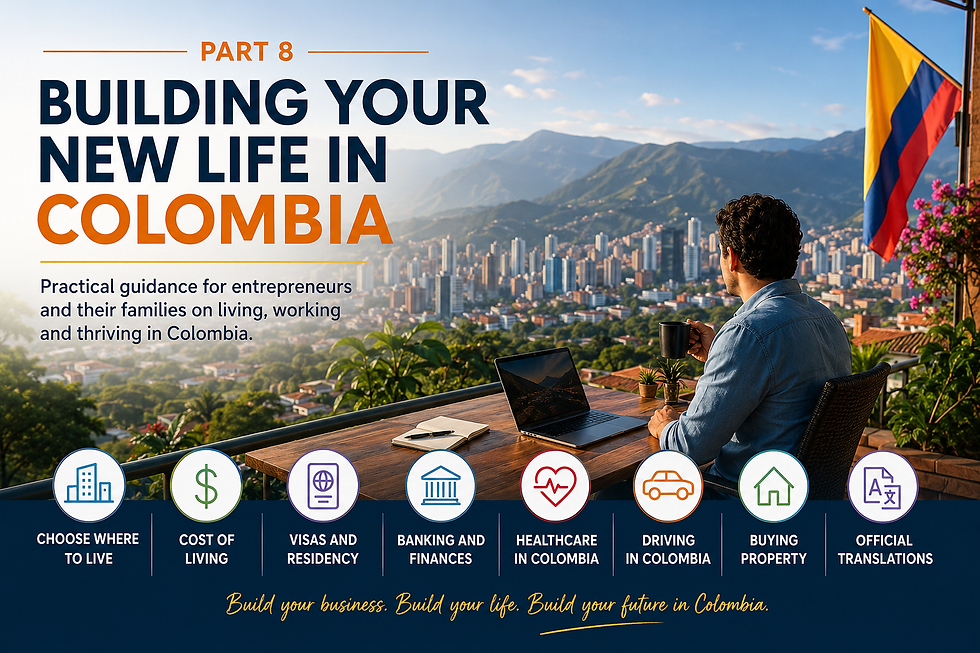
Building Your New Life in Colombia
By now, you should have a clear understanding of what it takes to start a business in Colombia.
We've explored company structures, registration procedures, taxation, banking, startup costs and some of the country's most promising business opportunities.
However, if there's one thing I've learned since moving to Colombia, it's that building a successful business and building a successful life go hand in hand.
Your business doesn't exist in isolation.
Where you choose to live, the visa you obtain, how you manage your finances, where your children go to school, how you access healthcare and even how you travel around the country all play an important role in your overall experience.
In many ways, these decisions are just as important as choosing the right business structure.
Colombia Is More Than a Place to Do Business
When people first begin researching Colombia, they often focus on practical questions.
Can I register a company?
How much tax will I pay?
Can I open a bank account?
Those questions are important, but after living here for several years I've come to realise that they only tell part of the story.
The bigger question is:
Can you see yourself living here?
For many international entrepreneurs, the answer turns out to be yes.
Colombia offers something that has become increasingly difficult to find in many parts of the world—a combination of business opportunity, natural beauty, welcoming people and a lifestyle that encourages a healthier work-life balance.
No country is perfect, and Colombia certainly has its challenges, but for many people the advantages far outweigh the drawbacks.
Choosing the Right City
One of the first major decisions you'll make is where to base yourself and your business.
Fortunately, Colombia offers an impressive variety of cities, each with its own personality and economic strengths.
🏙 Bogotá
As the nation's capital and largest business centre, Bogotá is home to multinational companies, financial institutions, government offices and a vibrant startup ecosystem.
If your business depends on corporate clients or international connections, Bogotá may be the logical choice.
🌿 Medellín
Often described as Colombia's innovation capital, Medellín continues to attract entrepreneurs, technology companies and remote workers from around the world.
Its pleasant climate, modern transport system and growing international community have made it one of Latin America's most popular cities for digital businesses.
🌴 Cartagena
For entrepreneurs involved in tourism, hospitality, international trade or luxury real estate, Cartagena offers unique opportunities combined with a beautiful Caribbean setting.
☕ The Coffee Region
Cities such as Pereira, Manizales and Armenia provide a slower pace of life while still offering excellent infrastructure and growing business opportunities.
Many entrepreneurs and retirees are increasingly choosing this region for its quality of life.
Other cities including Cali, Barranquilla, Bucaramanga and Santa Marta may also be ideal depending on your business sector and lifestyle preferences.
If you're still deciding where to settle, don't miss our detailed guides to Moving to Colombia and Living in Colombia, where we compare different regions, lifestyles and practical considerations for new residents.
💡 From Experience
One of the best decisions I made was taking time to understand the country before making long-term commitments.
Every city has its own character.
Spend time exploring, talk to local residents and visit different regions before deciding where to establish your business and your home.
Understanding the Cost of Living
For many entrepreneurs from the United States, Canada and Europe, one of Colombia's biggest attractions is its affordability.
Accommodation, domestic services, dining out and many day-to-day expenses can be considerably lower than in cities such as Toronto, Vancouver, New York or London.
However, it's important to avoid thinking only in terms of "cheap."
The real advantage is value.
Many entrepreneurs discover that the same budget which barely covers basic expenses in their home country provides a far more comfortable lifestyle in Colombia.
At the same time, imported products, luxury goods and international schools may cost more than expected.
Understanding these differences is essential when planning both your personal and business finances.
Our complete Cost of Living in Colombia guide explains typical monthly budgets, compares major cities and helps you estimate realistic living expenses before making the move.
Choosing the Right Visa
Your immigration status is just as important as your business registration.
The visa that's best for you will depend on your personal circumstances and long-term plans.
You may be:
investing in Colombia;
working remotely while exploring opportunities;
relocating with your spouse or family;
or planning to become a permanent resident.
We've prepared detailed guides covering several of the most common options:
Planning your visa strategy early can make opening bank accounts, registering your business and settling into life in Colombia considerably easier.
Banking and Managing Your Money
Opening a Colombian bank account is often one of the first practical steps after arriving.
Having a local account makes it easier to receive payments, pay suppliers, manage everyday expenses and build a financial history in Colombia.
If you'll continue working with clients overseas, you'll also want to think about international transfers, foreign currency and how you'll move funds between countries efficiently.
Because every bank has its own procedures, we've created a separate guide to Opening a Bank Account in Colombia, based on both official requirements and first-hand experience.
Healthcare for You and Your Family
One topic that pleasantly surprised me after moving to Colombia was the quality of healthcare.
The country has an extensive healthcare system supported by both public and private providers.
Many expatriates choose private health insurance because it offers quick access to specialists and modern medical facilities.
Colombia has also become internationally recognised for medical and dental tourism, attracting patients from North America, Europe and elsewhere seeking high-quality treatment at competitive prices.
If healthcare is an important consideration for your move, our comprehensive Healthcare in Colombia guide explains how the system works, while our Dental Treatment in Colombia guide explores why thousands of international patients travel here every year.
Driving in Colombia
If your business involves travelling regularly, or you simply enjoy the freedom of having your own vehicle, you'll probably want to understand Colombia's driving regulations.
Requirements vary depending on your nationality, how long you've been living in Colombia and whether you're using a foreign driving licence.
We've covered everything in our practical Driving in Colombia guide, including licences, buying a vehicle, insurance and useful tips for driving safely in different parts of the country.
Buying a Home
Many entrepreneurs initially rent while getting to know the country.
Others decide to purchase property once they've settled.
Foreigners are generally free to buy property in Colombia, and compared with many countries, the purchasing process is relatively straightforward provided you obtain appropriate legal advice.
Whether you're looking for a city apartment, a coffee farm, a coastal home or commercial premises, our Buying Property in Colombia guide explains the buying process, legal checks, taxes and common pitfalls to avoid.
Don't Forget Your Documents
One aspect of relocating that many people underestimate is paperwork.
Depending on your circumstances, you may need official translations of:
birth certificates;
marriage certificates;
university degrees;
police clearance certificates;
company documents;
powers of attorney;
financial documents.
Many of these will also require an apostille before they can be used in Colombia.
Preparing your documentation before beginning visa, banking or company registration procedures can save a great deal of time and frustration.
Through Altus Traducciones®, we've helped thousands of individuals and businesses prepare official translations for immigration, investment, property purchases, company registration and legal procedures.
As a Colombia-based company, we're familiar with the documentation most commonly requested by government authorities, banks and other institutions.
💡 From Experience
If I could give one piece of advice to anyone planning the move, it would be this:
Stay organised.
Keep digital copies of every important document.
Maintain a checklist.
Ask questions whenever you're unsure.
Most importantly, don't rush.
Relocating to another country is one of life's biggest decisions, and good preparation makes every stage of the journey easier.
Final Thoughts
When I first arrived in Colombia, I couldn't have imagined where the journey would lead.
Like many people, I had questions, uncertainties and more than a few concerns.
Over time, those concerns were replaced by opportunities.
I've built a business, established a home and come to appreciate the warmth of the people, the diversity of the country and the possibilities it offers entrepreneurs willing to embrace something new.
Is Colombia the right place for everyone?
Probably not.
Every entrepreneur has different goals, priorities and expectations.
But if you're looking for a country that combines opportunity, affordability, talented professionals, beautiful surroundings and an increasingly international outlook, Colombia deserves serious consideration.
I hope this guide has helped answer many of your questions and given you the confidence to explore the possibilities further.
Whatever stage you're at—still researching, planning your move or ready to register your company—I wish you every success with your Colombian adventure.
After all, every successful business begins with a single decision.
Perhaps this is yours.


Comentarios